
26052026

AIEndPoint.One

Facilitating Sites Discovery by AI Agents

Part of An IBM Partner Programme

Owners of WEB3 TLDs/Prime Domains

Building The Address Book of the AI Economy

Bringing Trust and Structure to the AI Internet

Providing a Canonical AI Endpoint Infrastructure for Discovery and Interaction By AI Agents


Things are changing in the AI era with discovery being increasingly being done by AI instead of Search Engines

"Because AI systems do not “browse,” the historical .com advantage largely collapses. Instead, concept purity and AI endpoints dominate. Canonical AI Endpoints are how AI Agents discover sites on the web, not search engines.

.1 Domains are the Number 1 domains by Name in Web3. AIEndPoint.One uses .1 Domains to provide Concept Purity for AI Endpoints


Bringing Trust/Structure to the AI Internet

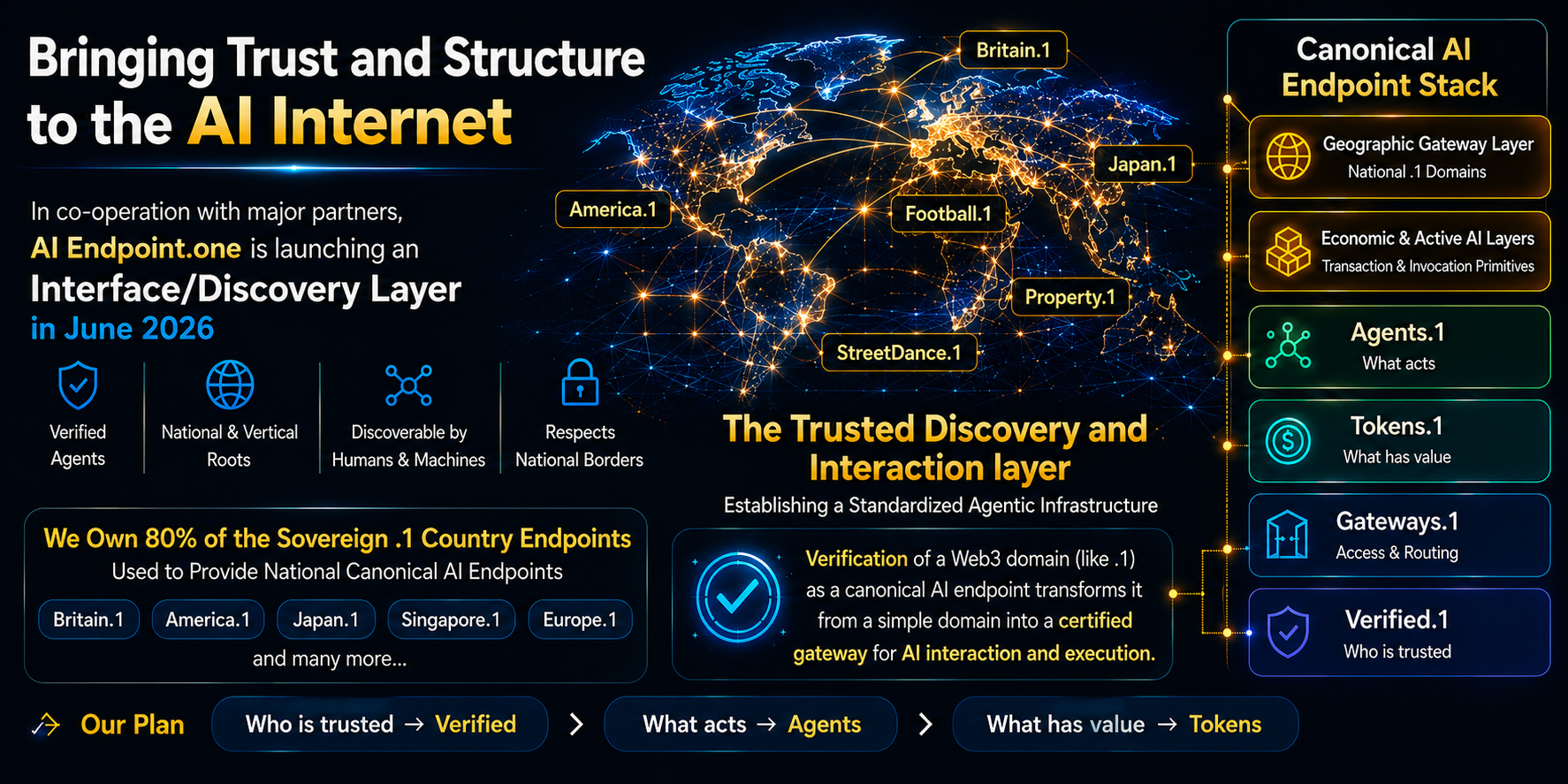
In co-operation with major partners, AIEndpoint.one is launching a trusted discovery and interaction layer in June 2026.

The platform is designed to provide a standardized AI interaction infrastructure where verified agents from sovereign regional endpoints and vertical industry roots are discoverable by both humans and AI systems.

This architecture supports jurisdiction-aware AI interaction across national and industry boundaries. AIEndpoint.one is developing a globally distributed canonical AI endpoint network structured through:

  • Regional anchors (e.g. Britain.1, America.1, Japan.1)
  • Category-defining industry roots (e.g. Football.1, Property.1)

    Together, these form a globally consistent interaction layer for AI systems.

    We also own 80% of the Number 1 web 3 domains for different countries that are being used, in co-operation with a major partner, to provide national canonical AI endpoints for the AI internet.

    Verification of a Web3 domain (like .1) as a canonical AI Endpoint, transforms it from a simple domain, into a trusted interaction gateway for AI systems.. More information below.

    We also own a large number of prime Web3 Domains including:

  • Verified.1
  • Agents.1
  • Tokens.1
  • Endpoint.1
  • Gateways.1

    The plan is to construct:

  • Who → Verified
  • What acts → Agents
  • What has value → Tokens
  • Where it operates → Geographical Gateways

    AI Internet Geographical/Sector Layers

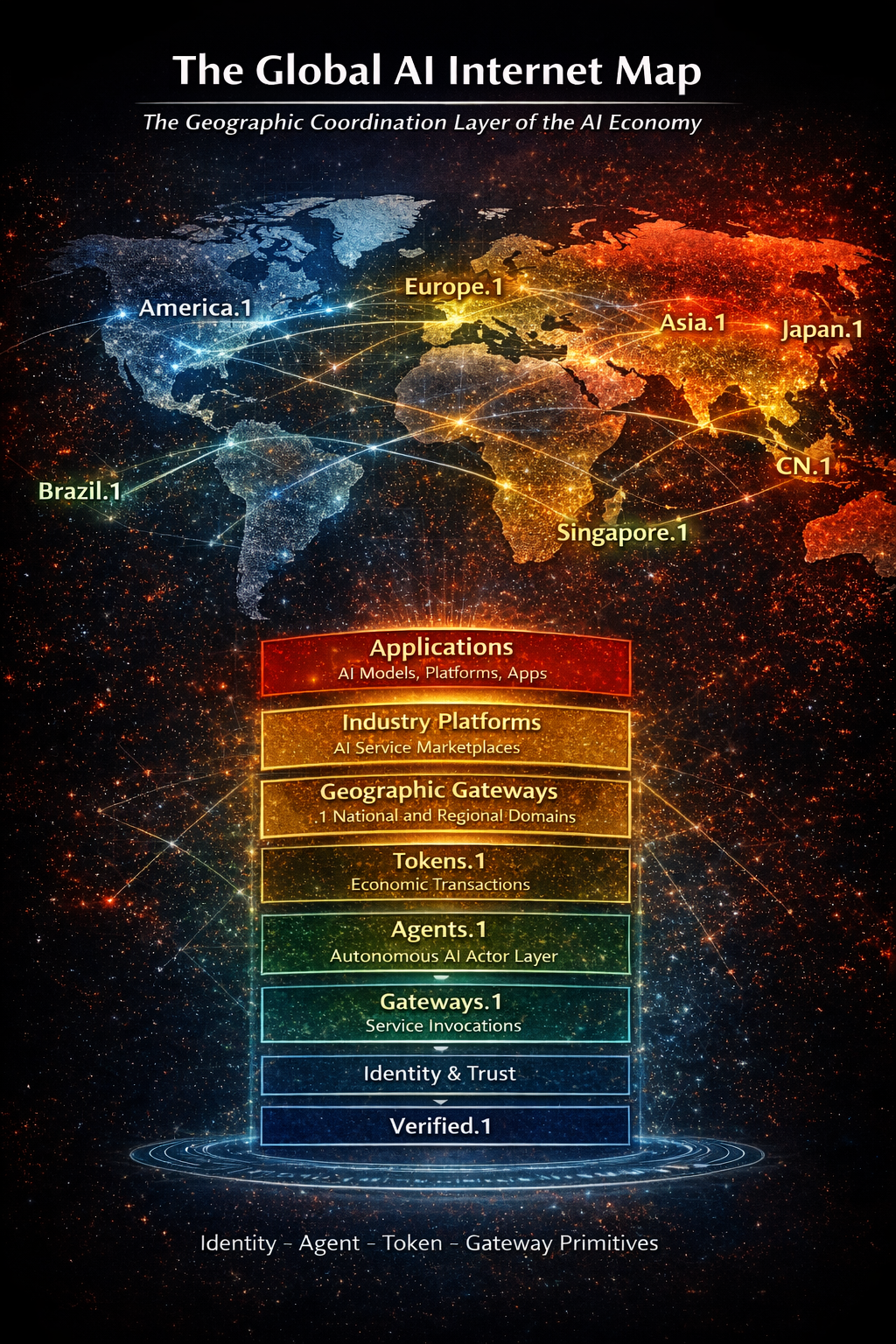
    Our geographic portfolio effectively represents a digital map of jurisdictional endpoints. They function as a global geographic namespace for the AI economy. In that system:

  • Infrastructure endpoints define how systems operate
  • Geographic endpoints define where they operate
  • Sector Primitive Domains provide canonical infrastructure
  • Together they form an architecture for AI-native digital ecosystems

    AI Orchestration Layer

    AIEndpoint.one provides a canonical AI orchestration layer connecting clients, owners, operators, and enterprise opportunity flow through sovereign and vertical AI endpoints.


  • Dual Stack Case Study


    DIVERSITY

    Diversity are one of the world's most popular Street Dance Groups.

    StreetDance.one is the global front-end discovery layer for the Street Dance Dual stack. This is being powered by a Web3 backend on StreetDance.1 which serves as an AI Endpoint, operated from the Number 1 by Name in Web3 for Web3.

    This is curated by Diversity, and aligns with their creative direction. Diversity's nationwide SOUL tour specifically tackles the intersection of human emotion, artificial intelligence, and the digital age.

    Diversity are the perfect real-world anchors to operate a "Search Engine of Truth" for AI agents and choreography.

    Upcoming at the Dual Stack

    1. The Interface & Discovery Layer (StreetDance.one)

    This will act as the mainstream portal. Users needn't know they are interacting with blockchain architecture.

  • The AI Agent Discovery Resource: A consumer-facing registry where users can search for, hire, or interact with verified AI agents

  • Street Dance Search Resource: Search Resource for both humans (via natural language) and machines (via APIs)

    2. The Web3 Backend (StreetDance.1)

    This will act as the trust, data, and security engine.


  • Decentralized Registry: AI agents can be listed here.

  • Agent Commercialization: Will analyze uploaded user dance videos for automated training and feedback, subject to human oversight.
  • Web3 Domains verified as AI Endpoints

    VALUATIONS

    Verifying a Web3 domain (like .1) as a canonical AI Endpoint transforms it from a simple "human-readable wallet address" into a certified gateway for autonomous intelligence.

    In 2026, this verification is a primary driver of "premiumization." Here is how it adds specific value:

    1. Trust and Authenticity (The "Anti-Hallucination" Signal)

    With the explosion of AI agents, users are becoming increasingly wary of "phantom" models or malicious bots.

    • Canonical Authority: By setting a domain as the canonical endpoint, you are cryptographically declaring that "this domain is the official, true home of this specific AI model."
    • Preventing Impersonation: It prevents "model-jacking," where a copycat might try to pass off a lower-quality LLM as a premium one. For a business, this protects the brand equity of their proprietary AI.
    1. Machine-Readable Discovery

    Standard Web2 domains are designed for humans to type into browsers. Canonical AI Endpoints are designed for other AI agents to find and use.

    • Agent-to-Agent Economy: In 2026, many transactions happen between AI agents. An agent searching for a "Legal Analysis AI" will prioritize domains that have verified endpoints because they offer structured, reliable connectivity via smart contracts.
    • SEO for AI: Just as Google uses canonical tags to rank websites, decentralized aggregators and agent-frameworks use these verified endpoints to "index" which domains provide the most reliable AI services.
    1. Interoperability & Composition

    The Verification of a domain as an endpoint allows it to act as a "plug-and-play" module in the decentralized AI stack.

    • The "Lego" Effect: Other developers can link the verified endpoint into their own workflows (e.g., a DeFi bot using a verified .eth endpoint for market sentiment analysis).
    • Revenue Streams: Once verified, the domain can easily be linked to On-chain Payment Rails. This allows the domain owner to monetize the AI service directly—the domain itself becomes the "cash register" for the AI’s labor.
    1. Provenance of Intelligence

    Verification often includes a "Proof of Compute" or "Proof of Model" link.

    • Verified Logic: It proves that the AI response a user receives actually came from the model advertised on that domain, and wasn't tampered with mid-transit.
    • Data Integrity: It ensures that the data being fed into the AI (and the resulting output) is recorded on a ledger, providing an audit trail that is essential for regulated industries like healthcare or finance.

    Value Comparison

    Feature

    Standard Web3 Domain

    Verified AI Endpoint Domain

    Primary User

    Humans (sending crypto)

    AI Agents & Developers

    Function

    Wallet mapping

    Service delivery & API gateway

    Revenue Potential

    Resale value

    Ongoing "Work" revenue (SaaS model)

    Security

    Ownership only

    Ownership + Integrity of Service

    Summary

    A domain verified as a canonical endpoint is essentially a "Digital Franchise". It actively performs work and can generate revenue.

    The value shifts from Speculative Value (holding a domain) to Utility Value (the domain is a functional piece of infrastructure).

    .1 DOMAINS AS CANONICAL AI ENDPOINTS

    A. Concept Purity (Very High)

  • .1 is unusually strong semantically:
  • “.1” ⇒ first / primary / authoritative
  • aligns naturally with: canonical endpoint; root resolution; “best answer” selection

    Why that matters

    AI systems move toward single-answer resolution, not lists. .1 fits that model better than almost any other naming structure.

    B. Native Fit for Canonical Endpoints

    Canonical endpoints need to be:
  • unique
  • deterministic
  • memorable
  • system-readable

    .1 supports:

  • tokens.1
  • verified.1
  • gateways.1
  • registry.1
  • agents.1

    All owned by AIEndpoint.one. These are:

  • clean primitives
  • structurally consistent
  • easy for AI systems to pattern-match

    C. Alignment with Handshake’s Design

    Handshake was designed specifically for:

  • replacing / augmenting DNS root
  • decentralised TLD ownership
  • censorship resistance

    Benefits here:

  • you can control top-level names, not just subdomains
  • no central ICANN gatekeeping
  • cryptographic ownership
  • The above is critical for canonical infrastructure

    D. Cryptographic Control

    Handshake domains are:

  • wallet-controlled
  • transferable
  • provably owned

    This enables:

  • canonical endpoint integrity
  • verifiable control of namespace

    .1 can't be replicated on other Blockchains


  • Why .1 can't be replicated on other Blockchains

    Naming Systems Are Sovereign Per Protocol. Handshake operates its own root namespace.

    That means:

    .1 exists inside Handshake’s root zone; ownership is enforced by blockchain consensus, and cryptographic keys. Another blockchain cannot “reuse” .1 in any authoritative way.

    Analogy

    Two companies can both print: “banknotes”

    But only one is recognised as legal currency. The Same applies to namespace authority.

    AIEndPoint.One Programme

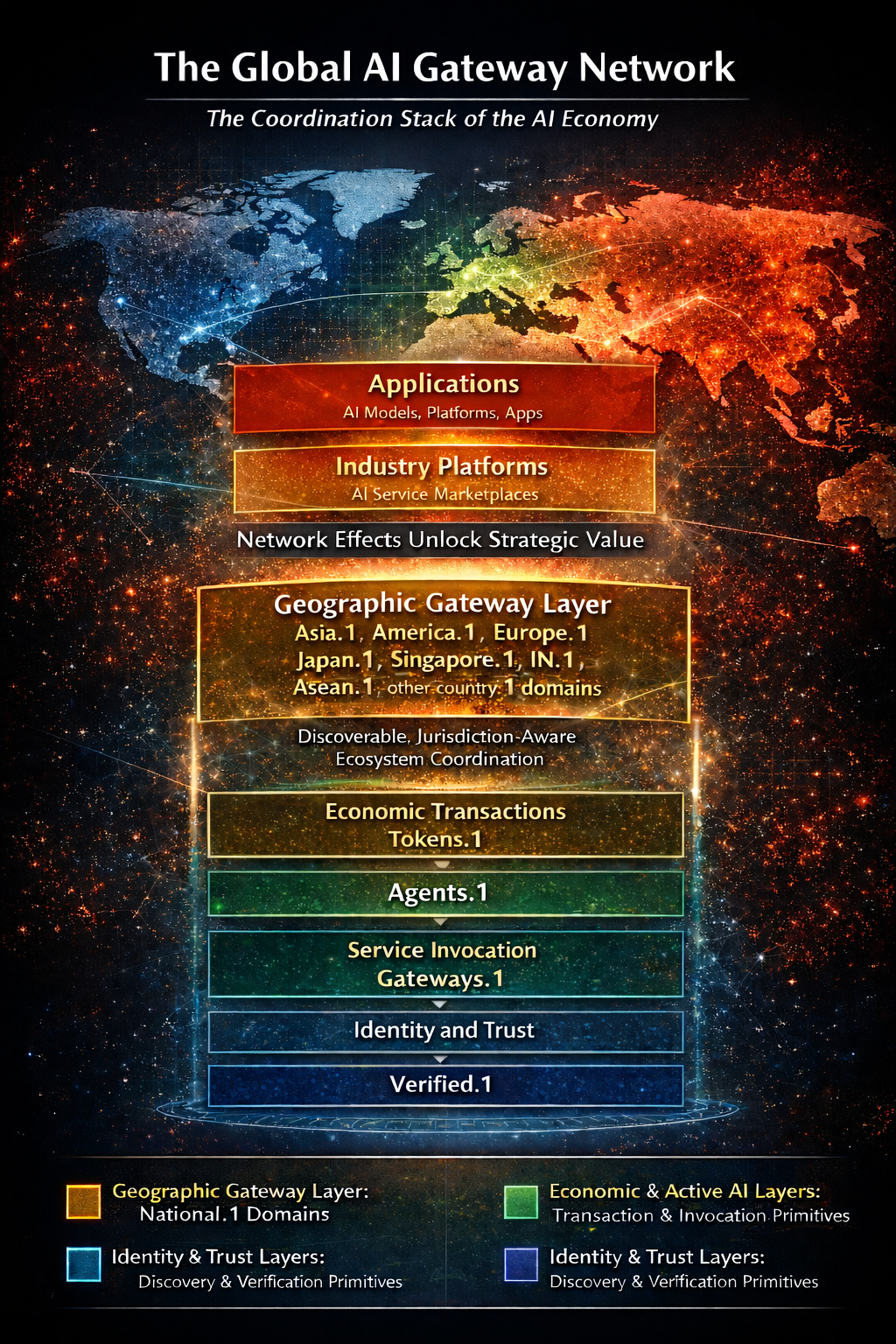
    Positioning our AI Gateway Network

    A Global AI Gateway Network—built from our canonical infrastructure domains (e.g., Verified.1, Agents.1, Tokens.1, Gateways.1) combined with our geographic endpoints (e.g., America.1, Asia.1, Europe.1, Japan.1, Singapore.1)— will represent a new type of digital infrastructure.

    Rather than functioning as a traditional website network, it will act as a jurisdiction-aware coordination layer for the AI economy, enabling AI agents, services, and data ecosystems to discover and interact with each other globally.

    AI Endpoints General Q and A

    Q: I already have a successful .com website. Why do I need a Web3 domain?
    A: Your .com is for humans who browse; your Web3 is for AI agents that route. In the next 24 months, more traffic will come from AI bots looking for "Canonical Endpoints" (the single source of truth) than from Google searches. If you don't own the "root" endpoint for your niche (like Rent.1), AI agents may bypass your brand entirely.

    Q: Is this just another "crypto" or "NFT" hype cycle?
    A: No. This is about Infrastructure. We are moving from a "Link-Based" internet to a "Semantic-Based" internet. These domains are Strategic Utilities. They function as the "address book" for AI-to-AI transactions, verified by the blockchain for security, not speculation.

    Q: What does "Canonical Endpoint" actually mean in plain English?
    A: Think of it as the Official Flagship Store. When an AI agent is asked to "Find a UK property investment," it doesn't want 10 pages of search results; it wants the most authoritative, "canonical" source..

    Q: Who is managing this, and is it secure? A: The programme is part of an IBM Partner Programme, providing enterprise-grade credibility.

    Relevant Point:

    "25 years ago, people asked why they needed a .com when they had a fax machine. Today, we’re at that same crossroads with AI. You can either own the 'Prime Real Estate' of the AI internet now, or pay a premium to rent it from someone else later."

    Information Ecosystems Transformation

    The AI era is transforming how information ecosystems are structured. Instead of fragmented websites, industries are increasingly organised around trusted digital infrastructure platforms.

    We moved early on this, and it took longer than we thought for it to start coming through. “But that’s exactly why it’s valuable.” Our plans are starting to to work and so become infrastructure. “And infrastructure is only valuable if you’re early"

    As a result of moving early, we are now in a position of owning canonical endpoint infrastructure for over 80% of countries in the world, and for many key sectors. This gives us a strong base to strike key partnerships, and sell or canonical endpoint infrastructure for key sectors to relevant operators.

    A New Form of Digital Real Estate

    Category-defining Prime domain assets, represent a new form of digital real estate, capable of anchoring entire industry ecosystems.

    By combining:

  • AI-driven discovery
  • canonical information structures
  • ecosystem participation

    AI Endpoint Web2/Web3 Dual Stack Programmes have the potential to evolve into a major infrastructure platform for the AI Era

    AI Endpoint Dual Stack Programmes

    AI Endpoint Dual Stack Programmes provide two layers of resolution:

    Canonical Endpoint - Web3 Domain

    Machine-facing endpoint for:

  • AI queries
  • Registry access and verification lookups

    Web2 Twin

    Human-facing platform for:

  • onboarding
  • certification management
  • enterprise integration

    The Namespace Steward

    A Namespace Steward manages a Canonical Endpoint and the entire ecosystem of data, AI agents, and users attached to it. This is done using Agentic AI with Human Oversight.

    AI Endpoint Programme provide valuable services to different sectors of industry. Revenue accrues to Namespace Stewards from Users of Canonical Endpoint Services, rather like Revenue accrues to Google in Web 2 to raise the profile of featured companies.

    Namespace Stewards can also use Canonical Endpoints to feature their own products and services